

Why most transformations don’t fail because of strategy, but because leaders never build the will to change.
We often think transformation is limited by ideas or plans. This is rarely the case, as it stalls when leaders fail to create the energy, ownership, and shared belief required to move forward.
Hello there, it’s Giuseppe here, and welcome to a new post from the Better Leadership Newsletter.
I might be talking about transformations quite often lately, but that’s perhaps because I’m facing this topic quite intensively in the last quarters. Today, starting from a great McKinsey article (I’ll put some data in here as well), we’ll see how there’s a moment in every transformation where the strategy stops being the problem.
The direction is clear. The initiatives are defined. The targets are ambitious, but realistic. And yet, nothing really moves. Not because people don’t understand the change, but because they don’t feel part of it.
This is where most transformations quietly lose momentum. Not in the design, but in the absence of collective will.
If you look closely, the organizations that sustain change are not necessarily the ones with better strategies. They are the ones where leaders manage to activate something harder to build: energy, ownership, and belief at scale.
Transformation, in this sense, is not just an execution challenge. It’s a leadership one.
Transformation doesn’t fail in the plan. It fails in the system of people around it.
Leaders often approach transformation as a sequence of initiatives:
define the roadmap
assign owners
track execution.
But what actually determines success is something more systemic.
Do enough people feel responsible for the change?
Do they see how it connects to their work?
Do they believe it’s worth the effort?
In many organizations, the honest answer is no.
A small group drives the transformation while the rest of the organization observes it from a distance. And when change is something “others” are doing, it rarely sticks.
What stands out in high-performing transformations is different. They expand ownership far beyond the usual core team. They treat participation not as a byproduct, but as a design principle.
Because the real leverage point isn’t just capability, it’s commitment.
So, first step, you should elevate ownership before you try to scale execution.
Most transformations rely on too few people.
A small group of leaders or program owners carries the burden, while the majority of the organization remains only loosely connected to the effort. That imbalance creates fragility. The change depends on too few nodes.
What the best leaders do instead is expand the core early.
They intentionally elevate a meaningful share of the organization into active ownership roles. This includes people across levels, especially those closest to the work.
And the shift here is subtle but important: you’re not asking people to “support” the transformation, you’re asking them to shape it. That changes the dynamic entirely.
In practice, this means:
Making the transformation meaningful, not just operational
Actively involving frontline employees in redesigning how work happens
Placing your strongest talent on the most critical initiatives
Bringing in external perspectives where needed to challenge inertia
Creating conditions where people can take on more without burning out.
When this works, something interesting happens. The transformation stops feeling like a program and starts behaving like a movement inside the organization.
As next step, build a coalition, not just a communication cascade.
Once a core group is activated, many leaders make a predictable mistake. They try to “roll out” the transformation through communication. Town halls. Slides. Emails. Cascades. Sounds familiar?
But communication alone doesn’t change behavior. What changes behavior is what people see around them.
This is where a broader layer of leaders becomes critical, not as messengers, but as role models.
Middle managers, informal influencers, supervisors…these are the people who shape how the organization actually behaves day to day. If they embody the change, it spreads. If they don’t, it stalls, regardless of how clear the strategy is.
The role of leadership here is not to control the message, but to activate this layer:
Give them space to interpret and challenge the change
Involve them as thought partners, not just executors
Encourage experimentation, even when it creates discomfort
Allow them to challenge existing norms and ways of working.
There’s a tipping point in every organization.
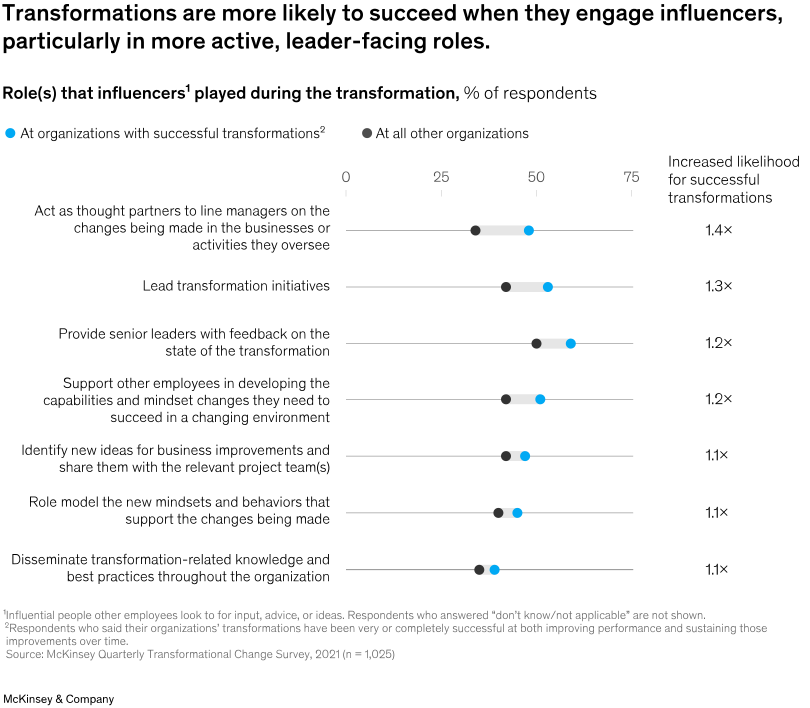
When enough people, not just at the top, start behaving differently, the system begins to shift on its own. But that only happens if leaders stop treating change as something to communicate, and start treating it as something to be lived.
Last step, energize the organization! Don’t just align it.
Even with ownership and role modeling in place, one element is still often missing. Energy.
Transformation requires more than clarity. It requires momentum. And momentum comes from how leaders engage people emotionally, not just rationally.
This is where many organizations default to the familiar: top-down messaging, carefully crafted updates, structured cascades.
It’s not wrong, but it’s insufficient.
Because people don’t commit to change because they received information. They commit because they understand why it matters, and where they fit into it.
The leaders who get this right do a few things differently. They don’t just communicate the strategy. They translate it into context:
What does this change mean for this team?
What will be different in our day-to-day work?
Why is this worth the effort for us, not just the company?
They also shift from broadcasting messages to creating conversations.
Instead of a few high-level moments, they enable thousands of small, local dialogues. They equip managers to handle questions, resistance, and ambiguity, because that’s where real alignment happens.
And importantly, they use personal narratives. Not polished corporate language, but real stories that connect the transformation to something tangible. Something the single person can feel.
Remember that energy doesn’t scale through slides!
Where leadership really shows up in transformation.
If you look at these three steps more generally, there’s a pattern across all three of them.
Elevating ownership is about who is involved
Empowering change leaders is about how behavior spreads
Energizing the organization is about why people commit.
None of these are purely structural decisions. They are leadership choices.

And they require a shift in mindset, from managing transformation as a program, to leading it as a system of people, behaviors, and meaning.
Most organizations don’t struggle with knowing what to do. They struggle with activating enough people to do it. And that’s where leadership becomes visible. Not in the strategy deck. Not in the announcement, but in the ability to create ownership, model behavior, and generate belief consistently, across the organization.
If you liked reading this post, I’d be grateful if you decided to share it with your coworkers, friends, family, or leave a comment below.
Have a good day or night, and see you in the next one!